Sign in. It’s quick, free and it’s up to you.
An account is an optional way to support the work we do. Find out more.
Sign in. It’s quick, free and it’s up to you.
An account is an optional way to support the work we do. Find out more.
A CHART THAT compares the finances of fictional Irish and Ukrainian families repeats misconceptions about how refugees from Ukraine in Ireland are treated.
The chart is headed “Irish families want to be treated equal to Ukrainians” and compares a Ukrainian family, represented by silhouettes of two adults and two children, with an “Irish family, including genuine foreigners that made Ireland their home and immigrated”.
The chart has been shared more than 100 times since being posted on Facebook on 8 October.
The hypothetical Irish family’s situation is laid out on the left side, and contains claims such as “can’t save for a deposit or mortgage” and “struggle to make ends meet”.
This is in contrast to the hypothetical Ukrainian family on the other side, whose corresponding entries to the right of the chart read “have money to go on holidays” and “Save money. Have bought houses to rent when living in free accommodation”.
However, many of the entries are based on false information.
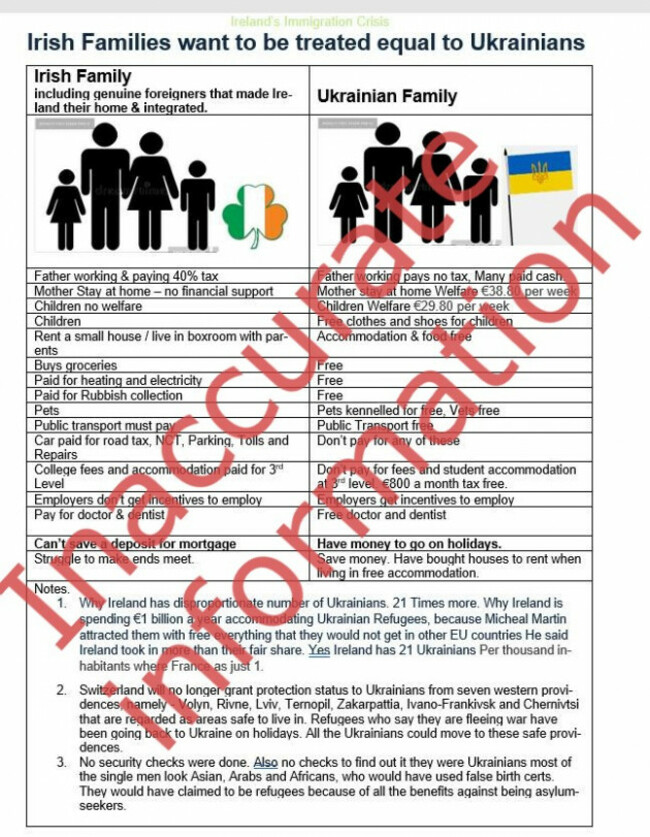
For example, the chart says that Irish families receive no welfare for their children. This is not the case.
Irish families receive €140 in child benefit every month for any child that is being supported by them.
The chart also claims that Ukrainian families receive free public transport. When they first arrive in the country, people fleeing Ukraine can use public transport for free to get to their accommodation.
However, as a rule, Ukrainians living here do not receive free public transportation thereafter.
The chart also says that Ukrainians get groceries for free. This may effectively be the case in designated accommodation centres, which provide food, laundry and other services.
However, Ukrainians arriving to Ireland are only permitted to stay in these centres for 90 days, far from enough time to save up enough money to buy a house, as the chart implies.
The chart also claims that the pets of Ukrainians are kennelled for free, and they get free visits to the vet.
Ukrainian pets had been kennelled by the state, though this scheme ended in 2022.
Similarly, while there had been a charitable scheme to help Ukrainians seek veterinary care for their pets, this has long since ended.
The chart also repeats the long-debunked claim that Ukrainians get their cars repaired for free. They do not.
The claims made in the chart echo previous inaccurate claims that seek to imply that Irish people are at a disadvantage to Ukrainians, including in an inaccurate chart that compared the treatment of apprentices, which was shared widely last month.
The Journal has also previously debunked claims that the government is giving migrants €60,000 to start new businesses; that asylum seekers are exempt from income tax for a year after they are allowed to work; that the High Court had ruled ‘illegal immigrants should be paid €318 per week’; that immigrants get shorter prison sentences than Irish citizens; that traffic rules do not apply to non-Irish people; that the Irish government had created a grant for Ukrainians to start their own businesses; and that the government is offering tens of thousands of euro to coax Indians to live on Ireland’s small islands.
The Journal’s FactCheck is a signatory to the International Fact-Checking Network’s Code of Principles. You can read it here. For information on how FactCheck works, what the verdicts mean, and how you can take part, check out our Reader’s Guide here. You can read about the team of editors and reporters who work on the factchecks here.

To embed this post, copy the code below on your site















have your say